By Sarah Dyce
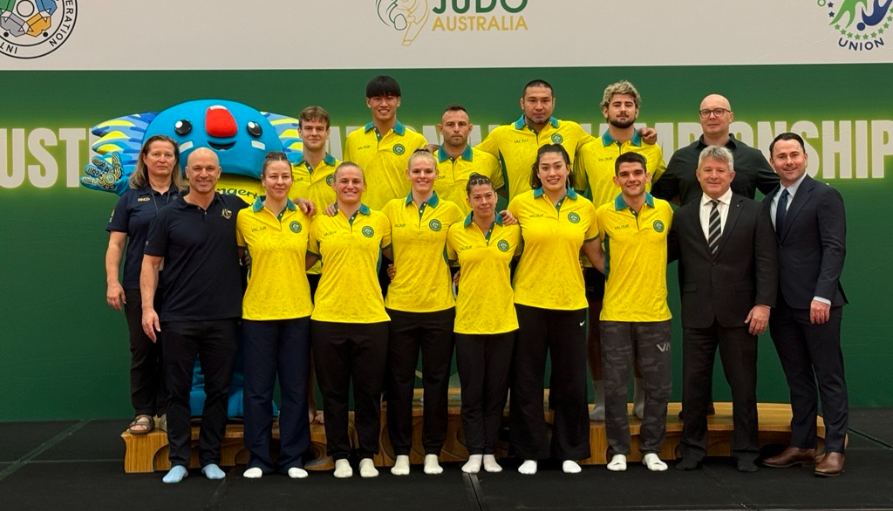
A mesmerising battle of confidence, tactics and skill returns to the tatami when Judo hits SEC Centre Hall 4 for Glasgow 2026, with two pairs of Australian siblings among the 11-strong squad chasing history on the mat.
Overview
Australia’s Glasgow 2026 judo team blends four athletes with Commonwealth Games experience and seven debutants, spanning nine confirmed weight divisions of the sport’s 14, plus one still to be confirmed.
Two family pairs headline the squad, and both share a division with a teammate. In the women’s draw, sisters Aoife (VIC, 70kg) and Maeve Coughlan (VIC, 63kg) are joined by Tinka Easton (VIC, 52kg), Maria Swan (WA, 78kg) and Saya Middleton (WA, 63kg), who lines up in the same division as Maeve Coughlan. On the men’s side, Vas Middleton (WA, 66kg) is joined by Pedro Antun Neto (NSW) and Joshua Katz (NSW), who both contest the 60kg, Keishin Ochi (WA, 81kg), Danny Vojnikovich (VIC, 90kg) and Kayhan Ozcicek-Takagi (NSW, +100kg).
At 20, Vas Middleton and Ochi are the joint-youngest members of the squad, while Antun Neto, 36, is the most experienced by age. Victoria leads the state representation with five athletes, followed by three each from New South Wales and Western Australia.
Ones to Watch
Australia
The sibling storyline set up in the Overview carries real weight in Glasgow. Aoife and Maeve Coughlan, and Saya and Vas Middleton, give Australia two family pairs on the mat at the same Games, a rare enough feat on its own. It’s also a storyline with precedent: Nathan and Josh Katz both competed for Australia at Birmingham 2022, and Josh returns again in Glasgow, this time with his brother as his coach.
Family ties aren’t the only thread carrying over from Birmingham. Aoife Coughlan and Tinka Easton both arrive as defending champions, having won gold at the 2022 Games in what were then their respective weight divisions, giving Australia two genuine title defences to follow through the week.
International
Australia isn’t the only team with a personal storyline running through Glasgow. Canada’s Christa Deguchi, the first judoka to win both Olympic and Commonwealth Games gold, was expected to defend her women’s 57kg title in Glasgow. The Paris 2024 gold medallist unexpectedly retired in March, citing a loss of competitive drive, meaning Canada won’t be represented in that division at all.
Scotland’s Sarah Adlington will attempt to close out her career by becoming the first judoka to win gold medals at three different Commonwealth Games, headlining the women’s +78kg on home soil. Only Adlington and England’s Ashley McKenzie, who now competes for Jamaica, have won judo gold at two Commonwealth Games.
Sport Format
Judo is contested on a 14m x 14m mat called a tatami. Two athletes attempt to score by throwing an opponent onto their back, off balance, or by controlling them on the ground. A throw that lands an opponent square on the back with force and speed scores an ippon and ends the contest immediately; a throw landing an opponent partly on the back or side earns a lesser score. Grappling is allowed, but there’s no kicking or punching. Holding an opponent down for 20 seconds also earns an ippon and ends the contest, with lesser scores awarded for holds of 10 or 15 seconds. A submission from an armlock or a strangle can end a contest the same way. Contests run four minutes unless they finish early by ippon.
Each weight division is completed in a single day, contested from lightest to heaviest. Competitors are drawn into two tables, with the top eight seeded so they can’t meet in the early rounds. Winners advance through single elimination, with the two table winners meeting for gold and silver. The four quarter-final losers contest two repechage bouts, and each repechage winner then faces the losing semi-finalist from the opposite table, with the winners of those contests awarded bronze. Two bronze medals are awarded in every weight category; the repechage losers finish equal fifth, and the earlier repechage losers finish equal seventh.
Scoring runs on three levels: ippon (a full point, and an outright win), waza-ari (half a point) and yuko, the lowest score, which returned to international judo in 2025. If a bout runs the full four minutes without a clear winner, the judoka with the higher score, or fewer penalties, takes the win. A scoreless or tied contest goes to Golden Score, sudden-death overtime decided by the next score or penalty.
Competition Schedule
Judo runs from Friday 31 July to Sunday 2 August 2026 at the SEC, comprising six sessions across 14 medal events, with each day’s preliminary rounds through to bronze medal contests completed on the same day, weight division by weight division.
Fast Facts
- Judo competitors wear traditional uniforms called judogis, one athlete in white and the other in blue.
- Judo has featured at the Commonwealth Games on four previous occasions, Auckland 1990, Manchester 2002, Glasgow 2014 and Birmingham 2022, and was a demonstration sport at Edinburgh 1986.
- The word judo translates literally from Japanese as “gentle way,” and all judo terminology used in competition remains Japanese, including “hajime” to start a contest and “matte” to pause it.
- Australia sits fourth on the all-time Commonwealth Games judo medal table with 28 medals (4 gold, 3 silver, 21 bronze), behind England, Scotland and Canada.