
By Sarah Dyce
Australia’s four 3×3 teams left Glasgow with a full set of medals, but the route to the podiums was anything but straightforward.
Across a week at the Scottish Event Campus, the campaigns unfolded in very different ways: one side recovered from an opening defeat to win gold, another went unbeaten all the way, the men fought hard for silver, and the wheelchair women battled through an overtime classic before sealing bronze.
The wheelchair men’s campaign set the tone for resilience. The Wombats opened with a loss to England, then responded by finding momentum through the tournament, beating Kenya, Canada and Wales before handling Scotland in the semi-final and turning the tables on England in the gold medal game (19-13).
Eithen Leard, Tom O’Neill-Thorne, Tomas Klein and Luke Pople all had their moments, with O’Neill-Thorne’s all-court influence and Leard’s scoring edge proving especially important as Australia closed out back-to-back Commonwealth titles.
The Wombat’s in the wheelchair women’s competition took a different path, but one no less dramatic. Dominant in their victory over Nigeria (19-2), the team went down to home crowd favourites Scotland in the semi-finals (15-12).
Australia rallied to answer again in the bronze medal match, edging Canada with a 19-17 scoreline to finish with a bronze medal after a campaign built on composure under pressure.
Australia’s Gangurrus men, Jonah Antonio, Sam McDaniel, Jarred Bairstow and Jesse Wagstaff combined in a team that mixed scoring punch with physicality and control. England proved the one obstacle they could not clear, denying Australia gold 19-17 in a final that stayed in the balance before the last decisive stretch.
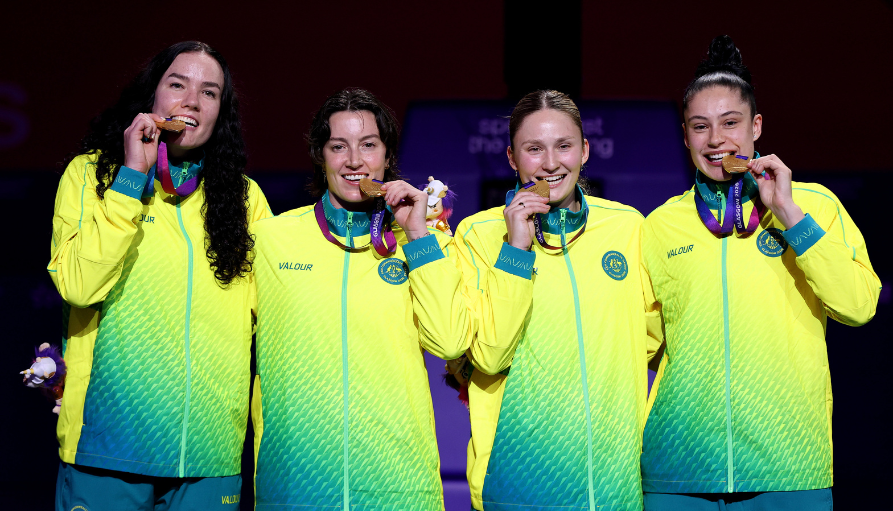
The Gangurrus women were the most dominant Australian team of the tournament. They swept through their campaign unbeaten and rarely looked troubled. Marena Whittle, Amy Atwell, Lara McSpadden and Emma Clarke all contributed to a side that controlled games with pace, pressure and shot-making.
With a dominant win over Jamaica in the semi’s (21-8) the only disruption to the team’s immaculate trajectory was Clarke’s injury, meaning Australia had to finish the final with three players. The response was emphatic: Whittle took over in the gold medal game against Uganda, and Australia completed a 21-11 win to round out a perfect tournament.
Australia’s Glasgow campaign ended with two golds, a silver and a bronze, but the deeper story was the variety of ways those medals were earned. Some teams led from the front, some had to claw back from early setbacks, and all four found their way to the podium.